CubeSat kit: what’s inside, and how to choose one.
A CubeSat kit is a small satellite you build yourself: a 10 cm cube with a flight computer, sensors, a radio and a battery, plus a ground station that receives its data. This guide explains each part, what to look for, and how the Hexstar kits compare.
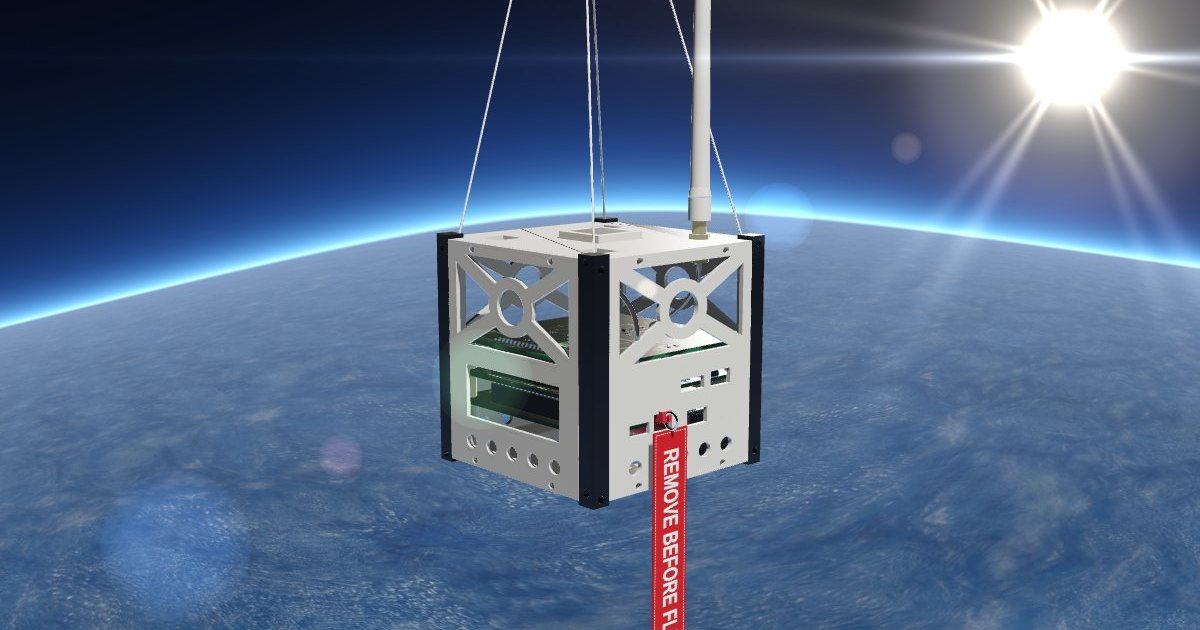
What is a CubeSat kit?
A CubeSat is a standard size of small satellite. One unit, called 1U, is a cube about 10 × 10 × 10 cm. The standard was created by Cal Poly and Stanford University in 1999 so that students could build real spacecraft cheaply, and hundreds of CubeSats have since been launched by universities, space agencies and companies.
A CubeSat kit gives you the same building blocks in a form you can put together on a desk: the frame, a flight computer, power, sensors and a radio. You assemble it, program it, and watch its data arrive live on a laptop through a ground station. Educational kits like Hexstar’s are made for learning and for near-space flights under high-altitude balloons, not for orbital launch.
What’s inside a CubeSat kit
Every CubeSat, from a classroom kit to a flight model, is built from the same subsystems. Knowing them makes it easy to compare kits.
1. Structure
The 1U frame holds everything together. In educational kits it is often 3D-printed, so schools can print spare panels. More advanced kits use rails and skeleton panels like flight hardware.
2. On-board computer (OBC)
The “brain” that runs your code, reads the sensors and decides what to send. Classroom kits use an Arduino Nano, which students can program in the free Arduino IDE. The Hexstar 1U uses a 48 MHz SAMD21 Cortex-M0+ with microSD logging.
3. Power system (EPS)
A battery plus the circuits that protect it and supply steady voltage. Look for a Remove Before Flight switch or key, which keeps the satellite off until launch, just like real spacecraft.
4. Sensors (payload)
What your satellite measures: temperature, humidity, pressure and altitude (for example a BMP280), motion and orientation from an IMU (MPU9250 or ICM-42688-P), and position from GPS.
5. Radio (communications)
Sends telemetry down to the ground. Basic kits use a 433 MHz link that works across a classroom or a field. LoRa radios reach much further, which matters for balloon flights that climb to 30 km.
6. Ground station
A receiver that plugs into a laptop by USB and shows every packet on a dashboard. Without one, you only see data after recovering the satellite.
How to choose a CubeSat kit
- Who is building it? For a school class, choose plug-in modules with no soldering. For university labs, choose flight-style boards with a stack bus and data logging.
- Do you need a ground station? A kit with its own receiver and dashboard turns the build into a live mission instead of a desk project.
- Will it fly? If you plan a high-altitude balloon launch, you need long-range radio (LoRa) and GPS so you can track and recover it.
- Can you program it? Arduino-based kits use tools most schools already know. Check that example code and lessons are included.
- Can you repair it? Modules in female headers and 3D-printable frames make it easy to swap a part instead of replacing the kit.
- What does it really cost? Compare the full price, including the ground station, battery, shipping and taxes.
Hexstar CubeSat kits compared
Hexstar builds three CubeSat kits in Kolkata, India, and ships them to 80+ countries. Teams at the University of Oxford, MIT, ISRO, IIT Kharagpur, IIT Madras, EPFL Space Center and the Bahrain Space Agency use Hexstar kits.
| Kit | Best for | Inside | Radio and tracking | Price |
|---|---|---|---|---|
| Hexstar Gen 1In stock | School classes, first builds, ages about 12+ | Arduino Nano, plug-in sensor modules, 9 V battery, 3D-printed 1U frame. No soldering. | 433 MHz telemetry to a USB ground station and live dashboard | ₹3,999 + GST in India $179 outside India |
| Hexstar Gen 2In stock | Senior school, college clubs, balloon flights | Arduino Nano, MPU9250 9-axis IMU, BMP280, ADXL335, temperature and humidity, Remove Before Flight switch | Long-range LoRa (Ra-02) plus NEO-6M GPS for live position and recovery | ₹8,999 + GST in India $299 outside India |
| Hexstar Gen 3 (1U)Pre-order | Universities, labs, advanced makers | Three stacked flight-style boards (EPS, OBC, LoRa) on a 40-pin bus, SAMD21 Cortex-M0+, 18650 cell, microSD logging | 868 MHz LoRa up to +22 dBm, GNSS (GPS + BeiDou), pocket USB ground station | From ₹25,000 + GST |
Indian orders pay in rupees with GST and ₹299 delivery. International orders pay in US dollars with $50 delivery; local import duties are extra.
What you can do with a CubeSat kit
- Learn space engineering by doing. Electronics, coding, sensors, radio and systems design in one project.
- Run classroom experiments. Log temperature, pressure and motion and plot them live on the dashboard.
- Test range. Take it to the rooftop or a field and see how far the radio link reaches.
- Fly to near space. Under a high-altitude balloon, a CubeSat can climb to around 30 km, send data all the way up and be recovered by GPS after the parachute descent.
See real builds and launches with students on our workshops page.
Frequently asked questions
What is a CubeSat kit?
A CubeSat kit is a set of parts to build a small 10 cm cube satellite: a frame, flight computer, power system, sensors and radio, usually with a ground station that receives its data on a laptop.
How much does a CubeSat kit cost?
Educational CubeSat kits range from a few thousand rupees to lakhs. Hexstar Gen 1 costs ₹3,999 + GST in India ($179 internationally), Gen 2 costs ₹8,999 + GST ($299), and the flagship Hexstar Gen 3 (1U) starts from ₹25,000 + GST.
Can a CubeSat kit go to space?
Educational kits like Hexstar’s are made for learning and near-space balloon flights to around 30 km, not for orbital launch. Flying in orbit requires certified flight hardware, testing and a launch provider.
Do I need to solder?
No. Hexstar Gen 1 and Gen 2 use plug-in modules in female headers, so the whole kit can be assembled and repaired without soldering.
Which CubeSat kit is best for a school?
For a first class project, Gen 1 is the simplest and lowest-cost. For older students or a balloon launch, Gen 2 adds GPS and long-range LoRa so the satellite can be tracked and recovered.
Do you ship CubeSat kits outside India?
Yes. Hexstar ships from Kolkata to over 80 countries. International orders pay in US dollars through PayPal, with $50 delivery; local import duties are paid by the buyer.
Start your mission
Gen 1 and Gen 2 are in stock and ship from Kolkata to India and worldwide. Gen 3, our flagship 1U CubeSat with three stacked flight boards, is open for pre-order. Schools and bulk orders get a custom quote.