DIY satellite kit: build your own satellite, in class.
A DIY satellite kit turns space science into something students can hold. They assemble a small CubeSat, program it, and watch its data arrive live on a laptop, then take it outside or send it up on a balloon. Here is what students learn, how schools run it, and which kit fits which class.
What students learn with a DIY satellite kit
How a satellite is wired
Power, sensors, the flight computer and the radio, and how they share one bus.
Arduino programming
Reading sensors, packing telemetry and sending it on a schedule.
The atmosphere, measured
How pressure, temperature and altitude change as the satellite climbs.
Talking to the ground
Antennas, range and why spacecraft send small, regular packets.
Analysing a mission
Plotting live telemetry and comparing it with predictions.
Systems engineering
Students split into power, payload, comms and ground teams, like a real mission.
How schools use a satellite kit
- Introduce the mission.What CubeSats are, why they are 10 cm cubes, and what this class’s satellite will measure.
- Build in teams.With plug-in modules there is no soldering, so a group can assemble and power up a Hexstar Gen 1 in one lesson.
- Code and test.Students upload code from the Arduino IDE and see sensor readings appear on the ground-station dashboard, ready to project for the whole class.
- Go outside.A playground or rooftop range test shows how radio links work and how far the data reaches.
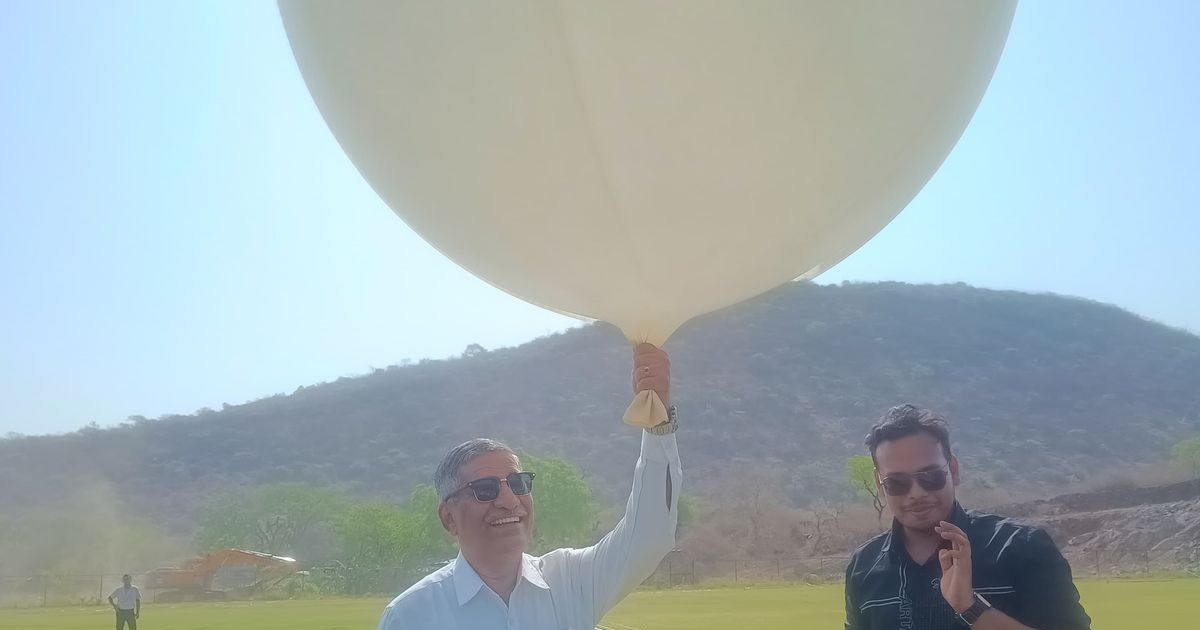
- Launch (optional).Older groups can fly Gen 2 under a high-altitude balloon, track it by GPS and recover it after the parachute descent.
Hexstar also runs CubeSat workshops and balloon launches with schools and universities, and offers a 10-week curriculum with the Classroom pack.
Which satellite kit for which class?
| Kit | Best for | Inside | Radio and tracking | Price |
|---|---|---|---|---|
| Hexstar Gen 1In stock | School classes, first builds, ages about 12+ | Arduino Nano, plug-in sensor modules, 9 V battery, 3D-printed 1U frame. No soldering. | 433 MHz telemetry to a USB ground station and live dashboard | ₹3,999 + GST in India $179 outside India |
| Hexstar Gen 2In stock | Senior school, college clubs, balloon flights | Arduino Nano, MPU9250 9-axis IMU, BMP280, ADXL335, temperature and humidity, Remove Before Flight switch | Long-range LoRa (Ra-02) plus NEO-6M GPS for live position and recovery | ₹8,999 + GST in India $299 outside India |
| Hexstar Gen 3 (1U)Pre-order | Universities, labs, advanced makers | Three stacked flight-style boards (EPS, OBC, LoRa) on a 40-pin bus, SAMD21 Cortex-M0+, 18650 cell, microSD logging | 868 MHz LoRa up to +22 dBm, GNSS (GPS + BeiDou), pocket USB ground station | From ₹25,000 + GST |
Ages are a guide: younger students can build Gen 1 with a teacher, and keen makers of any age can take on Gen 2 or the 1U.
Used around the world
Hexstar satellite kits are built in Kolkata and are used in more than 80 countries on six continents, by teams at the University of Oxford Physics Laboratory, MIT, Apple, NAVER, ISRO, IIT Kharagpur, IIT Madras, EPFL Space Center, Michigan Tech, the University of Athens, the Bahrain Space Agency and Paras Defence.
Frequently asked questions
What is the best DIY satellite kit for students?
For a first class project, a no-solder kit with its own ground station works best. Hexstar Gen 1 is built for classrooms; Gen 2 adds GPS and long-range LoRa for older students and balloon flights.
What age is a satellite kit suitable for?
Hexstar Gen 1 suits students from about 12 years with a teacher. Gen 2 suits senior school and college students, and the Hexstar 1U is aimed at universities and advanced makers.
Do schools get a discount on satellite kits?
Yes. Schools and bulk orders can ask for a custom quote through the enquiry form or WhatsApp at +91 93306 04060.
Can students launch the satellite?
Yes, under a high-altitude balloon with a parachute and a recovery plan, following local aviation rules. Gen 2 has GPS and LoRa so it can be tracked to around 30 km and recovered.
Is a DIY satellite kit the same as a real satellite?
It uses the same subsystems and 1U size as a real CubeSat, so students learn how satellites work, but it is an educational kit and is not certified for orbital launch.
Start your mission
Gen 1 and Gen 2 are in stock and ship from Kolkata to India and worldwide. Gen 3, our flagship 1U CubeSat with three stacked flight boards, is open for pre-order. Schools and bulk orders get a custom quote.